
In this article, we will explore the concept of domain authority, how it is calculated, and how to increase it for your website.

Add us to your preferred sources.

Domain authority is a metric that allows SEOs to predict a website’s ranking potential. For example, when proposing partnerships, link builders always communicate the authority of the domains they are working with. So, is domain authority really that important and, if so, how can it be improved?
What is Domain Authority?
In general, domain authority is defined as the relevance of a domain to a particular industry or subject. In search optimization, domain authority is a way to measure a website’s SEO strength and ranking potential. SEOs use domain authority as a relative metric to predict the likelihood of a domain ranking well in search engine results pages (SERPs)—a higher domain authority means the website has a better chance of ranking in organic results.
Alternative Metrics for Assessing Domain Authority
To measure domain authority, popular SEO tools have developed their own proprietary metrics. And while the criteria for evaluating domain authority vary from one tool to another, all these tools measure more or less the same thing: the SEO strength of a domain.
Here are some popular authority metrics:
Domain Authority (DA) is a score developed by Moz to predict the likelihood a website will rank in the SERPs. It is based on dozens of factors, including the quality and quantity of inbound links . Moz’s Domain Authority ranges from 1 to 100, with higher scores being more favorable for ranking.
This metric is calculated by a machine learning algorithm based on how often the domain in question appears for target queries relative to other sites on the SERP. Therefore, DA is a comparative, not an absolute, metric measured in the context of a specific competitive landscape.

Domain Rating (DR) by Ahrefs is a score to measure the strength of a website’s backlink profile in relation to other websites in their database, compared on a logarithmic scale of 100 points. To calculate DR, the tool considers the quantity and quality of all backlinks and also how many other unique domains link to each backlink source.
Keep in mind that even if your domain hasn’t lost any backlinks, its DR might change if other websites have acquired more authoritative backlinks.

Trust Flow (TF) and Citation Flow (CF) are two metrics developed by Majestic SEO to measure the quality and trustworthiness of a website. Citation Flow measures the number of links to a website, while Trust Flow measures the quality of those links.
If a website has a high Citation Flow but a low Trust Flow, this could indicate that the website has many low-quality backlinks.

Authority Score is a metric developed by Semrush to measure the strength of a domain. It ranges from 0 to 100 (with the higher score indicating a stronger domain) and takes into account a variety of factors, including link power (quality and quantity of backlinks), estimated average monthly organic traffic, and spam factors (indicators of spam compared to a natural link profile).

Domain Strength (DS) is a proprietary metric built into all four of the SEO PowerSuite tools. This complex metric score from 0 to 10 measures a website’s SEO strength based on a variety of factors such as domain’s InLink Rank, domain age, backlinks, social signals, etc. You can use this score to observe how domain strength grows with your optimization efforts.

Part of Domain Strength is a more specific metric Domain InLink Rankwhich considers only the number and quality of backlinks. This value estimates a domain’s importance on a logarithmic scale from 0 to 100. InLink Rank is based on the same algorithm as Google’s original PageRank and is determined by the number and quality of inbound links to the domain. The more authoritative domains link to your website, the higher its Domain InLink Rank.
As you can see, domain authority metrics are all relative scores. SEOs use such metrics to estimate websites’ potential, compare them, and plan SEO activities. Furthermore, this research shows that domain authority is approximately correlated with rankings: websites with higher authority scores (in any tool, as scores are correlated with each other too) generally rank for more keywords.+
How can I check my domain authority score?
This requires WebSite Auditor. You can download it for free now.
In each SEO PowerSuite tool, you can instantly check the Domain Strength score (Domain Authority) in the corresponding module. There you will see all the important factors that influence your domain authority, such as:
- Domain InLink Rank
- Domain information including age, IP address, and country
- The number of indexed pages in your preferred search engines
- The number of backlinks and unique linking domains, as well as IPs and C blocks
- The relationship between backlinksdofollow and nofollow
- Social media popularity (on Facebook and Pinterest)
- Organic traffic as per Google Analytics (you will need to first grant access to your channel ).
Furthermore, you can check the Domain Authority score from Moz via the free API . First, you need to define the key inPreferences > Moz API Settings . Next, click theSettings button in the top-right corner and tick the DA score to be visible in the report. Then, click theUpdate button to get the calculated or recalculated scores again.

What are the important factors for domain authority?
Domain authority is based on dozens of signals that can be roughly grouped into the following dimensions: backlinks, content, and overall website reputation. Some factors may be taken into account, others may be omitted: it depends on each tool and the methodology used to calculate the score.
So, let’s look at some of the known factors to see why they matter.
I Backlinks have been for decades the main ranking factor, not only for Google but also for other search engines. When it comes to domain authority, we want to know first and foremost how much we would benefit from getting a link from the domain.
The more backlinks a site has, the more prominent it seems to search engines. Meanwhile, not all backlinks are equal. For some time, Google’s PageRank was also available as a public tool that showed the strength of a page from the backlink point of view.
At this purpose, most backlink checkers have their own estimates of link value. For example, SEO SpyGlass evaluates the quality of a site’s backlink profile based on the following criteria:
- How many root domains (unique referring domains regardless of the number of backlinks) does a site have?
- What is the ratio of dofollow to nofollow backlinks?
- What are the link types (text, image, etc.)?
- Are the links not spammy (too many links from the same IP or C-block; or links from a link farm or PBN)?
- Are the anchor texts diverse enough?
The quality content is an integral part of improving domain authority. Content should be original, relevant, and engaging, and should provide value to visitors.
In this regard, good content:
- Is comprehensive and sufficient for the purpose of a page.
- Is original, well-written, and correct.
- Is optimized but written for people first.
- Includes original research, images, and other formats useful to the main content.
- Includes timely and verified facts, with citations from reliable sources (because using external links can help establish trustworthiness).
- Covers the topic in-depth and satisfies the searcher’s intent.
There are a lot of signals that show a website is trustworthy and reputable. However, the need for such signals may vary from niche to niche, depending on the type of business and the competitive landscape.
The quality rater guidelines (which received some major updates last year) shed light on how Google estimates the quality of a website. Among other things, these signals are crucial for website authority:
- The website is well-structured, navigation links are provided, and an informative homepage is discoverable.
- The website provides information about its authors, company, publishers, etc. (author profiles, links to active social media accounts, and About Us page).
- The website offers feedback opportunities (contact forms, customer service information).
Additionally, the update in the Rater Guidelines touched upon YMYL topics. Such pages need to be subjected to deeper scrutiny and require enhanced trust signals.
Websites that have been around for a long time tend to have a higher domain authority. An older website may have more backlinks and content, and it is easier for such a domain to establish authority and trust signals. Conversely, it might have changed ownership a few times because it was penalized. All these facts matter. That’s why, when you decide to take over an abandoned domain, or maybe you want to link-building collaborate with a brand new site, it’s good to know what’s been going on for years.
Organic traffic is all it is about. When we plan a marketing campaign or choose another keyword to optimize for, we want to know how much traffic it will bring us. So, most of the ranking checker tools have built-in traffic checking options to see (or better say roughly predict – when we mean estimates of someone else’s domain) if the website has live organic traffic on it.
Although user behavior is not a direct ranking factor (at least, it has never been named as such), the higher the engagement, the better for the page and the domain as a whole. And a site that gets a decent volume of tweets and shares will surely get great exposure and visibility. So, social signals are an additional signal that the domain is doing well.
How to Improve Domain Authority: Some Tips
Building your domain authority is a long-term strategy: it might take months and even years to achieve high scores. So, stick to your course and persevere: everyone once started from scratch.
Regularly publishing great content on your website is one of the most important steps to improving your website authority. Well-written, relevant, and engaging content can help your website rank higher in search engine results.
First of all, your content should be written for people. Always try to find trending topics, explore what your potential or existing customers are talking about, and research your competitors to find exciting content ideas.
Next, make sure your copy is written in a friendly tone of voice and is error-free.
Last but not least, make your content well-structured, readable, and search-optimized: because in the modern sense, texts optimized for people and for search engines mean roughly the same thing.
How
First and foremost, examine the quality of your content, using the Page Audit module with a page-by-page check in WebSite Auditor. In the Content Audit section, see what important elements are missing or poorly written. In the right-hand pane, you can quickly compare titles, headings, and meta descriptions from the websites of top competitors, read explanations for each factor, and get suggestions on how to improve it.

For each page you examine or plan to optimize, map the target keyword in the keyword research tool and check the page’s optimization score.

Next, to create better, well-written, and SEO-friendly copy, get help from the integrated Content Editor app in WebSite Auditor

The advice is drawn from competitive analysis of top competitors. Choose the recommended keywords that the tool discovers for you with the help of TF-IDF analysis. Additionally, you can expand your text with the help of topics and questions compiled from the FAQ and People Also Ask sections.
Good content won’t be able to rank unless you have an optimized and healthy website, so strong technical SEO is a given. Optimizing your website for search engines can help improve your website’s visibility and authority.
How
Check your website’s SEO health with WebSite Auditor. It will help you ensure your pages are crawlable and indexable, detect broken URLs and redirects, find duplicates, check alt text and hreflang tags, and verify tons of other technical SEO issues.
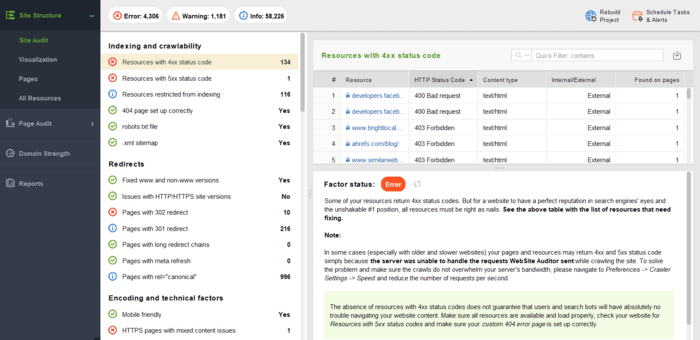
Additionally, websites should be mobile-friendly, as more and more people access websites via mobile devices. For page speed issues, connect the tool to the PageSpeed API and get an overview of all your bulk loading problems.
You can copy or export all your data in a CSV format or a PDF report and hand it over to your webmasters for correction.
Website navigation and accessibility are as important for domain authority as overall optimization. So, pay attention to the proper site structure and internal linking. It will help search engines discover and rank the most important pages on your site.
How
To analyze your site structure, use WebSite Auditor. In the Site Audit module, in the Pages section, you can see the click depth and examine the internal and external links on each page.

You can also use the visualization tool to evaluate your internal PageRank flow. Here you can change the view to see internal PageRank scores, page-by-page views, detect long redirects or unlinked pages, and even plan new pages and internal link changes.

Among other things, make sure you optimize your homepage and supplementary content correctly. Post important information about your company, terms, and policies. Also, if you run a local business site, add NAP (name, address, phone number if relevant), as it will help search engines (and visitors) understand your brand as an entity.
Links from authoritative sites can help you increase your domain authority. Try to get as many backlinks as possible from reputable websites. An example of high-quality link sources can be domains on popular resources in your niche or local media.
HowFirst of all, you can use SEO SpyGlass to check your site’s link profile. The backlink graph provides details on each linking source: domain and page InLink Rank, linking page, its HTTP status code, and even penalty risk score.
 The backlink checker contains several modules where you can analyze domains in bulk. The tool is useful for broken link building, competitor backlink gap research, and some other link magic.
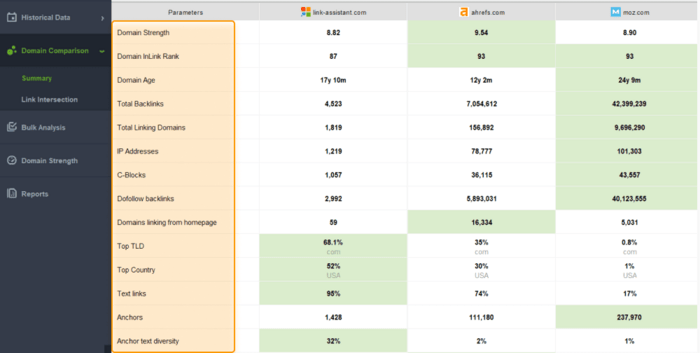 You can also use LinkAssistant with its highly detailed prospect research to find great linking sources. The tool has quick options to find websites that accept guest posts, niche directories by keyword and location, and even competitor backlinks, sorted by their recency.

Monitor your website’s performance to detect issues that can affect your website’s ranking. Keep an eye on the website’s page speed, broken links, and other technical issues.
How to
You can set up WebSite Auditor to automatically run a site audit once a month (or any interval you prefer). Once the scan is complete, the tool will email the report to your inbox or save it to your computer or cloud – set your preferred mode and let the tool do the routine for you.

Seeing what your competitors are up to is not only a necessity but also a source of new ideas. If you haven’t analyzed your competitors yet, it’s high time you do: explore content gaps and find linking sources you haven’t collaborated with yet.
How to
If you don’t know your organic competitors, ask Rank Tracker to suggest them. Enter a couple of seed keywords into the Competitor Research module, and the tool will show who you overlap with for the same keywords. Additionally, the intelligence tool will display competitor organic traffic and unique vs. intersecting keywords.
 The Top Pages section will find competitor top-level URLs, their main keyword, estimated organic traffic, and traffic value if the same traffic were bought via Google Ads.
 Then, you can add up to five competitors to your project and monitor their rankings alongside yours. Plus, the extensive Keyword Research section will suggest their high-volume keywords that can help you get tons of additional traffic.
Social networks can be a great way to build links and increase your website’s visibility. And build relationships with potential customers. You need to post content on social media regularly, share news about your business, and start discussions with your audience.
How to
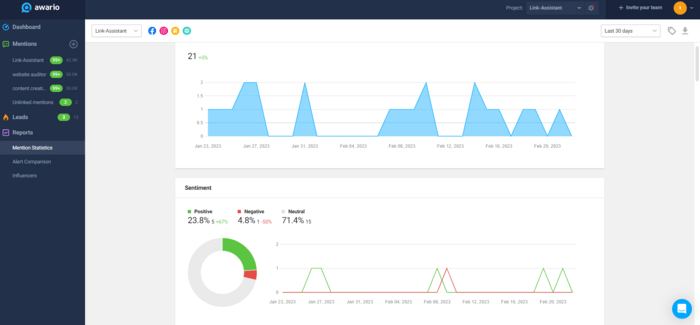
To help you with social media management, use the Awario social listening tool. Here you can see an overview of new mentions across all your social channels stacked together in one dashboard. You can also measure the prevailing sentiment around your brand and even discover leads among influencers and bloggers in your niche.
Conclusion
Domain Authority should not be a goal in itself, as it is a relative metric that only helps you with SEO and marketing. You can use any tool of your preference to observe how your Domain Authority improves: in this way, you will know that your SEO strategy is working.
Link Assistant Source
Pubblicato in Digital Marketing, SEO
Be the first to comment