
I discovered that my digital camera has a circle of confusion of 0.06. What does that mean? Does it have anything to do with the hyperfocal distance and depth of field? [5/8]
Add us to your preferred sources.

I discovered that my digital camera has a circle of confusion equal to 0.06. What does this mean? Does it have anything to do with the hyperfocal distance and depth of field?
Let’s start from the beginning, that is from the viewing distance. The rule for correctly viewing a photograph is to place it at a distance equal to the length of its diagonal. Therefore, if a photograph has been printed in the 20×25 format, to look at it properly we should place it at a distance of 32 cm. Why?
Because the human eye, when “healthy,” meaning neither myopic nor presbyopic, has a limited resolving power and sees all the small circles that have a diameter equal to 0.20 mm as if they were points: observing the photo from the correct viewing distance, the eye won’t make “reading” errors.
When the diameter of the small circle is larger or smaller than 0.20 mm, the eye will see blurring at the edges and the image will appear out of focus to us.
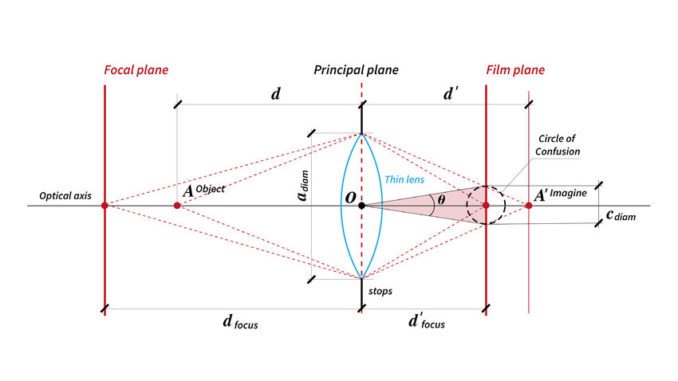
Let’s try to explain it better: by focusing on an image, each of its points is projected on the film plane and this point will correspond to the vertex of a cone. If the optics are of good quality and we have focused well, the dot will be infinitesimal; otherwise, it will have the shape of a small circle with a diameter more or less large.
Circle of confusion
Here, this is the so-called “circle of confusion.” Its size depends on the type of camera we are using and the magnification factor of the photographic print: the more the print is enlarged, the more the details blur; the closer we look at it, the more defects we will see. To know the size of our circle of confusion each time, we must divide the starting value by the magnification factor. So a 20×25 photo obtained by contact printing a negative of the same size, thus with a 1:1 magnification ratio, will have a circle of confusion equal to 0.20 mm.
If instead we print a 20×25 photograph starting from a 24×36 negative, which has a diagonal of 43mm, our original will be enlarged 7.56 times, and therefore its circle of confusion will be 0.026 mm. The sensors of digital cameras, except those of expensive “full frame” DSLRs, are much smaller than the traditional 35mm format, and obviously their circle of confusion is also smaller.
In simple terms, this means that with a digital camera we can’t print very large photos; otherwise, we will encounter the “out of focus” effect.
How can we minimize the problem? By stopping down the aperture. If we close the diaphragm blades, the light rays projected on the film plane will be less inclined, the vertex of our cone will have a sharper angle, and the circle of confusion will be smaller than the one obtained with wider apertures.
To have the sensation of greater sharpness, it is often convenient to use a wide-angle lens. The subject will have smaller details and the entire scene will appear more in focus. Let’s not forget the photojournalists’ rule: “f:8 and be there,” meaning set the aperture to 8 and be in the right place, and you will certainly bring home the photo.
However, it should be said that with optics designed for digital, the result obtained using aperture 8 is not comparable to that obtained with old manual lenses. It’s true that on one hand, due to the crop factor imposed by the small sensor size, to get a framing similar to the 35mm we will move farther from the subject, gaining something in the extension of the depth of field, but it is also true that the lenses mounted on digital cameras are less bright and require a smaller aperture than f:8, so an aperture of at least f:11 will be necessary.
Hyperfocal distance
Finally, the advice to use the hyperfocal distance remains valid; that is the value to set on the distance scale to get a focus range from about half the set distance to infinity. And since on modern optics the hyperfocal distance markings are no longer indicated, to calculate its precise value it can be useful to use the general formula f squared divided by N times c plus f, where “f” is the focal length, “N” is the aperture used, and “c” is the circle of confusion for a given print format. Too complicated? Fine, then you can use precompiled charts or calculation programs downloadable from the site http://www.dofmaster.com.
Complete photography course
- Photography course: which camera to choose?
- Photography course. The beginning: useful tips
- Photography course: sensitivity
- Photography course: blurred or shaky?
- Photography course: the circle of confusion
- Photography course: apertures
- Photography course: the battery
- Photography course: how to hold the camera


Be the first to comment