
OpenAI opens self-service access to ChatGPT Ads in Italy and numerous European markets: businesses and advertisers can now directly create advertising campaigns on ChatGPT.

Add us to your preferred sources.

Advertising on ChatGPT is entering a new phase in Italy and Europe as well. OpenAI has opened access to ChatGPT Ads Manager self-service in numerous European markets, allowing companies to directly create and manage their advertising campaigns on the platform. This new feature marks an important step in the evolution of OpenAI’s business model and, more generally, in digital advertising: alongside Google Ads, Meta Ads, TikTok Ads, and other major advertising platforms, there is now an environment where advertisers can reach users while they are conversing with an artificial intelligence, comparing alternatives and making decisions.
According to the official page on Ads Manager availability, self-service is now also available in Italy, France, Germany, Spain, Portugal, and many other European markets.
ChatGPT Ads Manager arrives in Italy and Europe
OpenAI announced on August 18, 2026, the expansion of ChatGPT Ads into several European markets. The first phase involved a more controlled access to advertising campaigns, while self-service was announced for a later phase. That phase has now taken place. The official page Ads Manager Availability by OpenAI indeed shows direct access to the platform available in Italy and numerous other European markets.
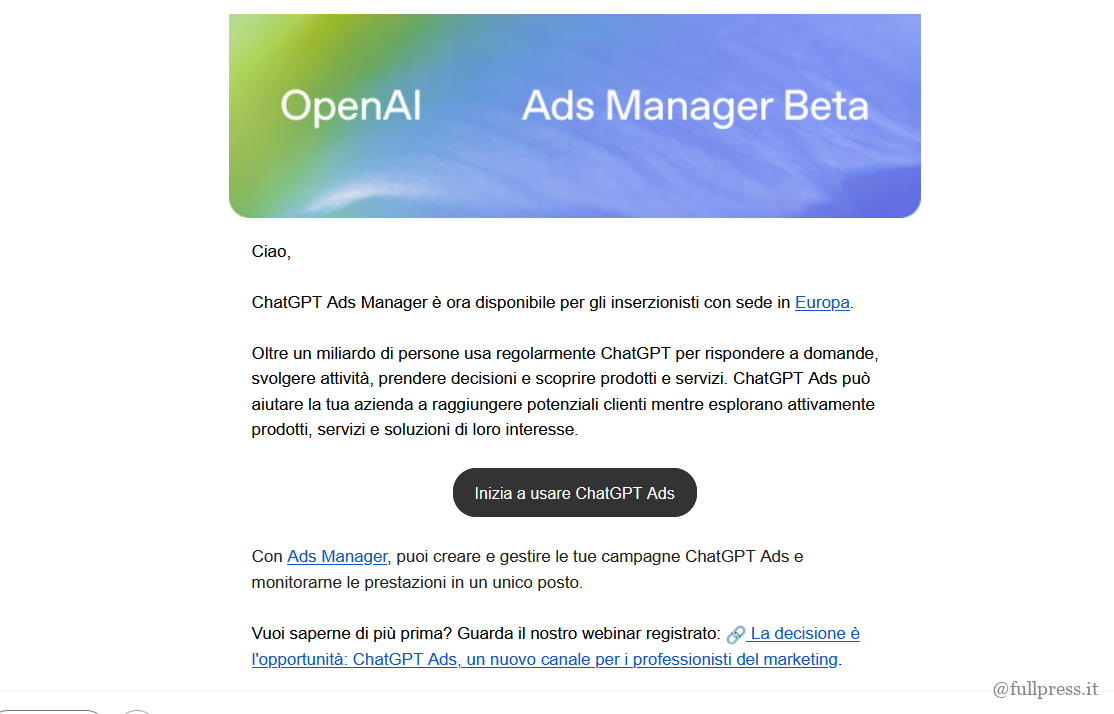
Thus, the availability does not concern only the Italian market but represents a true European opening of ChatGPT’s advertising platform. OpenAI is also communicating directly to European advertisers about the platform’s launch. In a communication dedicated to Ads Manager Beta, the company confirms that ChatGPT Ads Manager is now available to advertisers based in Europe and invites companies to start using the new advertising channel.
In the same communication, OpenAI highlights that over one billion people regularly use ChatGPT to answer questions, perform tasks, make decisions, and discover products and services. This decision-making context is one of the most interesting elements of the new advertising model.
OpenAI has also published a webinar dedicated to marketing professionals, titled “The decision is the opportunity: ChatGPT Ads, a new channel for marketers”, in which the platform’s functionality, targeting, safety, advertiser results, and onboarding process are examined in depth.
What is ChatGPT Ads Manager
ChatGPT Ads Manager is the self-service advertising platform through which advertisers can create and manage campaigns aimed at ChatGPT users. The principle is similar to existing advertising managers used in digital marketing: a company creates an account, sets up a campaign, defines budget and goals, prepares the ad, and then monitors its performance.
The real difference is therefore not so much in the existence of a new advertising panel, but in the context in which the ad can be shown. ChatGPT is increasingly used not only to obtain information but also to evaluate products, compare services, plan purchases, organize trips, or find professional tools. It is precisely in these moments that advertising can enter the user experience.
How advertising works on ChatGPT
OpenAI describes ChatGPT as an environment where people often arrive with a precise goal. A user might ask which software to buy for their company, which destination to choose for a trip, which computer best suits their needs, or which tools to use to solve a specific problem.
A conversation can therefore express a much more complex intention than a simple keyword typed in a search engine. Imagine, for example, a request like: “I’m looking for a simple CRM for a small agency of five people, possibly also usable from a smartphone and costing less than 100 euros a month.”
In this case, the system has much more information than the generic search “best CRM.” It is precisely this richness of the conversational context that makes ChatGPT Ads particularly interesting for marketers and advertisers.
Ads do not alter ChatGPT’s replies
One aspect OpenAI emphasizes heavily is the separation between advertising and the assistant’s responses. Ads are presented as separate sponsored content and do not determine what ChatGPT replies to the user. In other words, an advertiser can purchase advertising space but cannot buy a favorable response from the model nor intervene in the AI-generated content. This distinction is fundamental because the credibility of the answers is one of the most delicate elements in introducing advertising within a conversational assistant.
Who sees the ads on ChatGPT
The ads are not intended indiscriminately for all users. According to OpenAI, they can be shown to users of the Free and Go plans. The paid plans Plus, Pro, Business, Enterprise, and Edu remain ad-free. OpenAI also states that it does not show ads to accounts identified as belonging to persons under 18 years old. Advertising thus becomes one of the tools through which OpenAI can financially support free or low-cost access to ChatGPT.
Why ChatGPT Ads is different from Google Ads
The comparison with Google Ads is inevitable, but it would be reductive to consider ChatGPT Ads simply as a new advertising search engine. Google mainly captures a query. ChatGPT can instead understand a sequence of questions, needs, preferences, and constraints expressed during a conversation. This could allow identifying not only what a person is searching for, but also why they are searching for it and which features they consider important to make a decision.
For digital advertising, this means gradually shifting from the concept of keyword to that of conversational intent. This does not mean that Google Ads suddenly lose importance. Search advertising, social advertising, and conversational advertising respond to different logics and can coexist within the same customer journey.
From keyword to conversation context
For years, much of search marketing has been built around keyword choice. With generative artificial intelligence, this paradigm is already changing on the organic front as well. Companies and publishers are trying to understand how to gain visibility not only on search engines but also in the answers produced by AI platforms.
The arrival of advertising introduces a second level: alongside organic visibility in AI responses, a purchasable visibility. SEO, GEO, AI visibility, and conversational advertising could therefore become different components of an increasingly integrated strategy.
Which companies could benefit the most from ChatGPT Ads
It is still early to determine which sectors will achieve the best performance. Much will depend on costs, available volumes, and the actual quality of traffic. Some categories, however, seem particularly compatible with an environment where people use artificial intelligence to compare alternatives and make decisions.
- software and SaaS services;
- e-commerce;
- tourism and hospitality;
- education;
- professional services;
- technology and electronics;
- financial services allowed by advertising policies;
- B2B products and services;
- tools for professionals and businesses.
A hotel could, for example, intercept a person organizing a trip. A management software could reach an entrepreneur comparing different CRMs. An online service could present itself while the user is looking for a concrete solution to a problem. The potential value thus mainly lies in the ability to intercept moments of high intent.
How to start advertising on ChatGPT
With self-service availability, access does not necessarily require direct contact with OpenAI’s sales team. Companies operating in an enabled country can register directly through Ads Manager and set up their advertising account. In general terms, the process includes:
- creation of the advertising account;
- advertiser configuration;
- campaign creation;
- objective definition;
- ad group configuration;
- creative preparation;
- landing page selection;
- budget definition;
- geographical market selection;
- monitoring of results and conversions.
The platform is still relatively young and OpenAI is progressively expanding tools and features. Those who decide to experiment with it should therefore consider the first campaigns mainly as a testing and data collection phase.
Which metrics to monitor in the first campaigns
The risk when a new advertising channel is launched is to focus exclusively on the novelty. To understand whether ChatGPT Ads can actually generate value, it will be necessary instead to apply the same criteria used in other performance marketing channels. Among the data to observe will inevitably be impressions, clicks, CTR, traffic cost, and conversions, but for many companies it will be even more important to analyze what happens after the click. Quality of the visit, time spent on the site, contact requests, sign-ups, sales, and acquisition cost will be the indicators that will help understand if traffic coming from ChatGPT has different characteristics compared to that generated by search and social advertising.
The use of UTM parameters on landing pages will also allow clear distinction of traffic coming from ChatGPT campaigns within web analytics tools.
ChatGPT also becomes an advertising platform
The introduction of Ads Manager also represents a strategic step for OpenAI. ChatGPT is no longer just a tool based on artificial intelligence models, but an ecosystem that includes subscriptions, enterprise services, APIs, and now also advertising.
The evolution has been very rapid. After the launch of increasingly advanced models – as described also in FullPress’s in-depth article on GPT-5 and the evolution of ChatGPT – OpenAI is progressively building around the assistant a true economic and commercial platform.
Is ChatGPT Ads already a channel to invest in?
The answer, for the moment, cannot be the same for all companies. ChatGPT Ads is a young channel and there are still not enough historical data series to reliably compare costs and performance with Google Ads, Meta Ads, or other established advertising ecosystems. This does not mean it should be ignored. For companies that already have structured campaigns and reliable conversion measurement systems, it can be interesting to allocate a limited portion of the budget to an experimental phase.
The initial goal should mainly be to understand what kind of users come from ChatGPT, which conversations generate commercial opportunities, and what quality this traffic has.
Advertising enters the era of conversations
The arrival of ChatGPT Ads self-service in Italy and Europe therefore goes far beyond the launch of a new advertising manager. It marks the entrance of conversational artificial intelligence into the advertising market on a large scale. For years, companies have sought to appear when a person typed a specific word on Google or belonged to a particular audience on social networks. Now a third possibility opens: being present while a person is explaining to an artificial intelligence what they need. For marketers and advertisers, the question could therefore change. Not only: “For which keyword do I want to be found?”. But also: “In which conversation can my product become a relevant answer to a real need?” This is probably where one of the most interesting transformations of digital advertising in the coming years will begin.
Pubblicato in Artificial Intelligence


Be the first to comment