
Have you emptied the Windows Recycle Bin and realized you’ve deleted important files? Don’t despair! There are several solutions to recover deleted documents, photos, and other data. In this guide, we’ll show you the most effective methods to restore your precious files.
Add us to your preferred sources.

Accidentally deleting important files can cause serious problems and moments of panic. Fortunately, when you delete a file in Windows, it is not immediately physically removed from the storage device. Even after emptying the Recycle Bin, the data often remains recoverable until it is overwritten by new information. This guide will show you several methods to recover files deleted from the Recycle Bin, from built-in Windows solutions to using specialized software.
Understanding how the Windows Recycle Bin works
The Windows Recycle Bin functions as a temporary safety net for deleted files. When you delete a file, the operating system doesn’t physically remove it from your hard drive, but simply moves it to the Recycle Bin. This allows you to easily restore accidentally deleted files, at least until the Recycle Bin is emptied.
However, even after emptying the Recycle Bin, files are not completely deleted from the disk. Windows simply marks the space occupied by these files as available to be overwritten. The data physically remains present until new information is saved in that space. This is why it’s possible to recover files even after emptying the Recycle Bin.
It’s important to act quickly when you realize you’ve deleted important files. The longer you wait, the higher the chance that the data will be overwritten by new information. To maximize your chances of recovery, avoid using your computer or at least avoid saving new files to the affected disk until you have recovered the lost data.
Recovering files from an non-emptied Recycle Bin
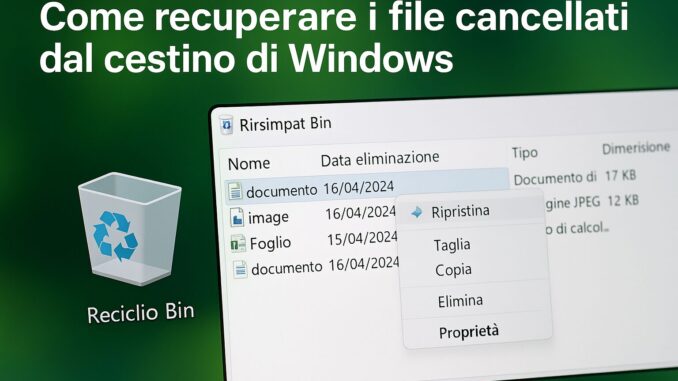
If you haven’t emptied the Recycle Bin yet, recovering files is a simple and immediate operation. Here are the steps to follow:
- Open the Recycle Bin by double-clicking its icon on the desktop.
- Locate the files you want to recover.
- Select the files (you can select multiple files by holding down Ctrl while clicking).
- Right-click on the selected files and choose Restore.
The files will be automatically returned to their original location. If you don’t remember where they were, you can see the original location in the “Original Location” column of the Recycle Bin’s details view.
This method only works if the files are still in the Recycle Bin and it has not been emptied. If you have already emptied the Recycle Bin, use one of the methods described below.
Using Previous Versions in Windows
Windows offers a built-in feature that might help you recover deleted files: Previous Versions. This function relies on system restore points or File History, if enabled.
To access previous versions:
- Open File Explorer and navigate to the folder that contained the deleted files.
- Right-click on the folder and select Restore previous versions.
- If previous versions are available, select the one that might contain the lost files.
- Click on Restore to restore the folder to its previous state.
If you have File History enabled (Windows 10/11):
- Open the Start menu and type “restore files”.
- Select Restore files with File History.
- Navigate to the folder that contained the lost files.
- Use the arrows to view previous versions.
- Select the files to recover and click on Restore.
These features are useful, but they only work if previously activated. Otherwise, move on to other methods.
Recover files with specialized software
When Windows’ built-in methods don’t work, data recovery software often represents the most effective solution. Here are three popular options:
Disk Drill
Disk Drill offers an intuitive interface and powerful recovery algorithms. The free version allows you to recover up to 500 MB.
- Download and install the program on an external drive (to avoid overwriting).
- Launch Disk Drill and select the affected disk.
- Click on Search lost data to start the scan.
- Once finished, preview the found files.
- Select the files and click on Restore.
Recuva
Recuva is a free solution developed by Piriform (the authors of CCleaner).
- Download and install the program.
- Launch the wizard and choose the file type.
- Select the location to scan (even the entire disk).
- Start the scan.
- Select the files and click on Recover.
Wondershare Recoverit
Recoverit is professional software with advanced features and a preview of recoverable files.
- Download and install the program.
- Select the affected disk.
- Start the scan.
- Preview the found files.
- Select the files and click onRecover.
Deep scans often find more items, but take longer.
Use the Windows command prompt
For advanced users, the Command Prompt can offer a recovery attempt:
- Open Command Prompt as administrator.
- Run:
chkdsk X: /f(replaceXwith your drive letter). - When finished, run:
ATTRIB -H -R -S /S /D X:*.*
You might recover files hidden with generic names, so identification is not always immediate.
Windows File Recovery: the official Microsoft tool
Windows File Recovery is a free tool (Microsoft Store) for Windows 10 19041 or later. It is used from the command line.
Basic syntax:
winfr unità-di-origine: unità-di-destinazione: /modalità /filtriExample (recover Word files from C to E):
winfr C: E: /regular /n *.docx- Regular mode: for recently deleted files.
- Extended mode: for long-deleted files or after formatting.
Prevent future data loss
- Create regular backups with OneDrive, Google Drive or external drives.
- Increase Recycle Bin size (right-click → Properties → Custom size).
- Activate File History for automatic copies of personal files.
- Use cloud services with versioning (OneDrive, Dropbox, Google Drive).
- Organize files with logical folders and descriptive names.
No method guarantees 100% recovery: time and disk usage after deletion are determining factors. Prevention, with regular backups, remains the most reliable strategy.
Conclusions
Recovering files deleted from the Windows Recycle Bin is possible with various approaches: from direct restoration of an unemptied Recycle Bin, to integrated tools (File History, Windows File Recovery), up to specialized software (Disk Drill, Recuva, Recoverit). Success mainly depends on the time elapsed and the activity on the drive after deletion: act quickly and invest in good backup practices to minimize risks.
Pubblicato in Guides & Tutorials
Be the first to comment