
Positive data for the professional robot market worldwide. In 2019, the sector recorded a +32%.
Add us to your preferred sources.

Positive signals are coming from the robotics sector. Italy ranks sixth in the world in this particular sector with a growing trend. According to estimates by the IFR (International Federation of Robotics) Covid-19 will amplify the growth of robotics worldwide. The value of sales of robots for professional services increased by 32% to $11.2 billion worldwide in 2018-2019 (Source IFR).
Medical Robotics
In terms of value, sales of medical robotics accounted for 47% of the total revenue of robots for professional services in 2019. This was mainly driven by robotic surgery systems, which are the most expensive type in the segment. Sales reached a new record of US$5.3 billion, an increase of 28%. By 2022, sales of medical robots have the potential to reach US$11.3 billion, effectively doubling revenue. Approximately 90% of medical robots come from American and European suppliers. (Source: World Robotics 2020 – Service Robots report).
Consider, now, the pharmaceutical industry in the era of Covid-19 when, clearly, it is experiencing a great boom. In addition to human resources, the pharmaceutical industry relies mainly on technologies: from the industrial robotic arm to increasingly precise digital components.
Robotics for Logistics
Logistics services also require increasingly high-performance precision and speed tools. Just look at the following graph to understand the enormous growth of the sector. Almost all of the logistics revenue was generated with robots for internal use. Autonomous mobile robots were initially used in warehouses, but with the digitalization of production, they are also part of today’s smart factory. Therefore, a continued strong growth in revenue of 40% or more per year seems possible. A niche to keep an eye on certainly.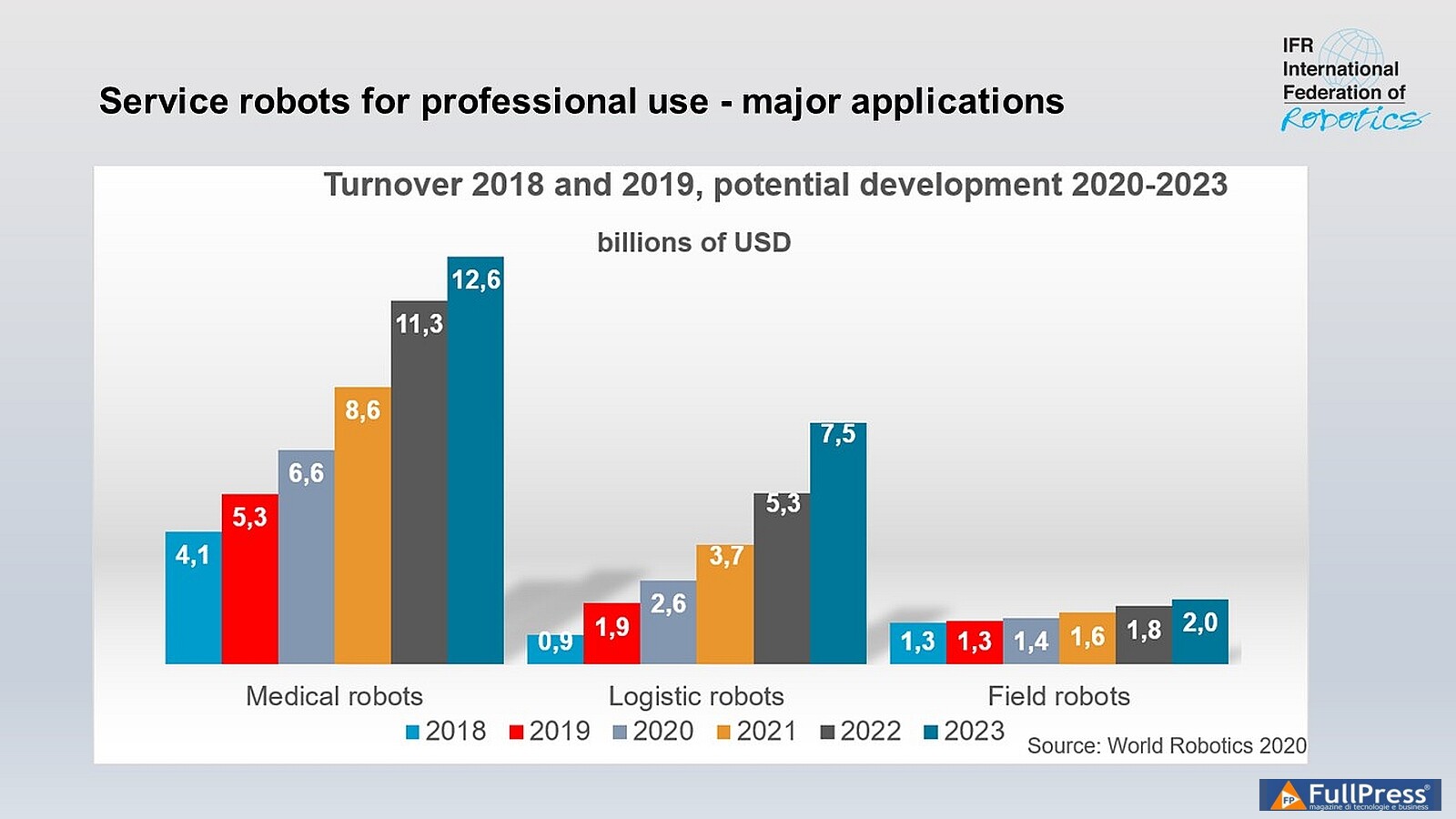 Professional robots ©World Robotics 2020[/caption]
Italy Consolidates Its Market Position
According to data provided by IFR, 373,000 new robots were sold worldwide in 2019, a 12% decrease compared to the numbers recorded in 2018. Italy, however, went against the trend, achieving a better performance than the rest of the world. Italy performed 7 times better than the world (-12%), more than 7 times better than Asia (-13%), almost 6 times better than Japan (-10%), 5 times better than China (-9%), and 14 times better than Korea (-26%), more than 7 times better than North America (-13%), and almost 3 times better than Europe (-5%)” (source Innovationpost). And it is precisely these numbers that have propelled Italy’s position forward, now at sixth place (previously eighth and then seventh) globally and second in Europe, immediately after Germany.
Industrial Robots
There are essentially three types of industrial robots. Here is a brief description:
- Six-axis robots,ideal for applications requiring complex movements and with ease of programming, with possible application ofArtificial Intelligence.
- Scara Robotsused mostly in robotic assembly applications. They typically have a base mounted in a fixed position with a rigid arm and rotational movement on the xy axes.
- Collaborative robots, also known ascobots, are used to perform delicate tasks that are impossible for traditional robots. Demand for this technology is increasing, and the global market for cobots is projected to reach $9 billion by 2025 (Source automazione-plus).
Be the first to comment