

Add us to your preferred sources.

Finding and evaluating the quality of a potential site is essential for successful link building. In this article, we will examine how to perform link prospecting in five simple steps.
What is link prospecting?
Link prospecting is the process of finding and evaluating potential sites from which to acquire links. This means identifying potential sites based on the type of link building strategy you are using, verifying the quality of that site, and finding the right people to contact as part of your outreach campaign. Link prospecting is the essential first step to building a strong link building strategy.
Why is link prospecting important for SEO?
Link prospecting helps you identify sites to acquire links from, and more importantly, it helps you identify sites to avoid. Since Google prioritizes “neutralizing the impact of unnatural links on search results,” the last thing you want is to intentionally attract any type of spam link to your site.
Naturally, every website can organically pick up a few spam links. Coupon sites and auto-generated blogs are just a couple of undesirable sites that might link to yours. However, link prospecting allows you to ensure that every link you build is intentional and adds value, improving your site’s relevance and authority in the eyes of search engines.
Link prospecting in five simple steps
Now that we know what link prospecting is and why it is important, we need to know how to do it practically. There are five key steps to link prospecting, so let’s look at those in more detail.
Step 1. Consider your link building strategy
The types of potential links you need to acquire and the methods you use to find them will largely depend on the tactics you intend to employ. The best link acquisition tactics to use include:
- Guest blogging
- Niche edits
- HARO link building
- Skyscraper link building
- Digital PR
- Linkable asset campaigns
It’s important to establish a clear strategy regarding the tactic you will use. If you will be using multiple tactics, you will need specific prospects for each type of campaign you intend to run. For example, if you want to try guest blogging, you need to identify relevant sites in your niche that meet your assessment criteria and are open to publishing content from guest authors. If, on the other hand, you want to run a skyscraper campaign, this will involve analyzing your competitors.
Step 2. Identify assessment criteria
You need to establish assessment criteria. What makes this site a good prospect? There are several useful metrics to weed out potentially poor prospects, including:
Relevance: will depend on your business, your goals, and your link-building efforts. There are two types of relevance: topical and geographic. If you want to acquire links to build perceived authority in search engines, you will need links from a site with high topical relevance.
Conversely, if you are looking to improve your local SEO and bring in business from local customers, you will want to build geographically relevant links from sites like other local businesses or news outlets, for example.
Domain Rating: a website’s DR is a good indicator of how strong its backlink profile is, as well as how much link equity it can pass to your site.
Organic Traffic: how much organic traffic a website gets each month can indicate the quality of the site and that the backlink profile has not been manipulated in any way. For example, a site might have an extremely high DR with zero traffic, which would be something to avoid.
Step 3. Find potential clients with relevant, high-quality links
Now that you have a clear link-building strategy and rating criteria, it’s time to start finding relevant and “high-quality” link prospects. You can use several methods to do this, and we’ll cover my top four in more detail.
Finding prospects through competitor analysis
Using competitor analysis is one of the quickest ways to find quality link prospects. Why? Assuming your competitors have already vetted the quality of these sites, the qualification process is likely much faster. And since these sites already link to your competitors, there’s a chance they’ll link to yours too.
Are your competitors primarily guest blogging? Using niche edits or HARO link building? This information can help you replicate your competitors’ link-building efforts and even the playing field in search engine results pages (SERPs). You can check your competitors’ links in a couple of different ways.
Finding prospects with Google and search operators
One of the easiest ways to find potential links is by using Google with the help of some advanced search operators. Use terms relevant to your business or niche and add modifiers like “guest post” or “write for us” to narrow down your results.
There are many search operators you can use to build a comprehensive list of prospects. For example, let’s look at a few search operators you can use if you’re finding prospects for guest blogging:
- “contribute”
- “guest post”
- “guest contributor”
- inurl:guest*author
- inurl:guest*blogger
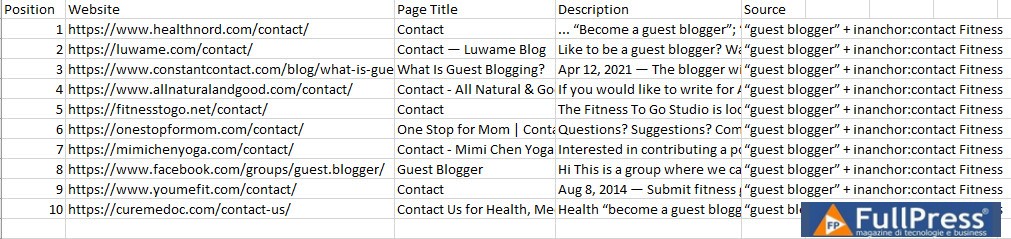
- “guest blogger” + inanchor:contact
- “guest article” + inanchor:contact
Using the appropriate search operators, you can build a list of prospects in a spreadsheet. You can even automate the process with thisfree Linkpitch tool.
Step 4. Analyze and rate prospects for quality and relevance
Once you’ve gathered a list of potential prospects, it’s time to rate them and prioritize the best ones. If you’ve followed the rating criteria, this should be a reasonably straightforward process.
Remember, we initially look over the rating criteria of relevance, Domain Rating, organic traffic, and traffic value.
Here are the parameters I tend to aim for:
- Relevance: relevant to the niche or relevant to my target audience, depending on the campaign
- Domain Rating: DR 40–80
- Organic traffic: 1000+ per month
- Traffic value: $1000+
These are the metrics I work with initially to qualify sites in the first overview stage. However, it’s important to note that you should be wary of metrics and not use them as the sole way to determine a site’s quality. Many authority metrics can be manipulated, so it’s always best to check each site to do your due diligence and avoid spam.
Remember that while buying links is against Google’s guidelines, it has become a common practice in our industry. Many website owners know the earning potential that comes with placing links.
For less experienced site owners who aren’t as skilled at spotting spam sites, there’s a big opportunity to discount any old site designed solely for selling links. It’s in a site like this’s interest to manipulate metrics and appear more authoritative than it is.
Here are a few things to look out for when spotting a spammy website:
- Poor and/or low-quality content
- Poor website design
- More display ads than content
- No “information” or “author” pages.
- Individual posts without specific authors listed (attributed to “Editorial Team” for example)
- Individual posts with many outbound links
Each site is worth checking individually. Sites that don’t measure up should be removed from your prospect list.
Step 5. Find Contact Details for Your Prospects
The main purpose of prospecting is to find sites to approach via outreach and acquire links from them. But you need the contact details as part of your research to reach out to them. This will be the last step in narrowing down your prospect list. Any potential sites for which you cannot find valid contact details can be removed from the list.
The easiest way to do this is to use an email lookup tool such as Hunter. This tool allows you to enter any domain, pulling up all associated email addresses and company information. Then, once you’ve found the relevant emails for your prospects, link them to a tool like Pitchbox to begin your outreach.
Conclusion
Link prospecting is an essential part of SEO, and it’s important to take the time to do your research and properly assess potential link partners. Remember to always check for quality and trustworthiness. Google penalizes sites with low-quality backlinks, so be sure not to overlook any potential signs of spammy sites. After you’ve identified a list of high-quality sites relevant to your niche or target audience, you can begin the outreach process and start acquiring some amazing links for your site.
Source: Ahrefs
Pubblicato in Digital Marketing, SEO
Be the first to comment