
Artificial intelligence is no longer just for big tech: today SMEs and service companies also integrate it to optimize processes, improve decisions, and innovate. It’s not just about automating, but about rethinking the business future with intelligent tools, guided by tailored consulting and strategies.

Add us to your preferred sources.

The artificial intelligence has become a pillar of innovation for companies, so it is no longer the exclusive domain of tech startups or visionary multinationals. Today, even SMEs, industrial groups, and service companies are beginning to integrate AI solutions into their processes, not just to “go faster”, but to rethink operational logic, improve the quality of decisions, and build new growth models.
What makes AI truly transformative is not its ability to replace humans, but its ability to amplify skills, process data more quickly, and support decision-making with contextual intelligence. From internal processes to customer relations, from marketing to financial analysis, the scope for impact is real and measurable.
Naturally, every business context requires a personalized approach. Technologies do not integrate into an organization on their own, and that is precisely why many organizations choose to rely on an artificial intelligence consultant, capable of understanding the specific needs of the company, evaluating the most suitable tools, and guiding a concrete and sustainable transformation process.
AI is rewriting the concept of efficiency
In business language, the word “efficiency” has always been synonymous with optimizing resources, reducing time, and cutting waste. But with AI, efficiency becomes proactive, because this technology, in addition to automating what the company already does, indicates where to intervene, anticipates bottlenecks, and suggests alternatives.
In the field of supply chain & logistics, for example, AI systems can predict supply chain disruptions, optimize distribution routes in real-time, and automatically adjust inventory based on estimated demand.
In the area of customer care, on the other hand, next-generation chatbots respond in natural language, learn from conversations, and improve the customer experience by reducing waiting times and management costs.
Or we have examples of integration in quality control, where thanks to computer vision and machine learning, it is possible to analyze images or data in real-time during production, detecting defects invisible to the human eye.
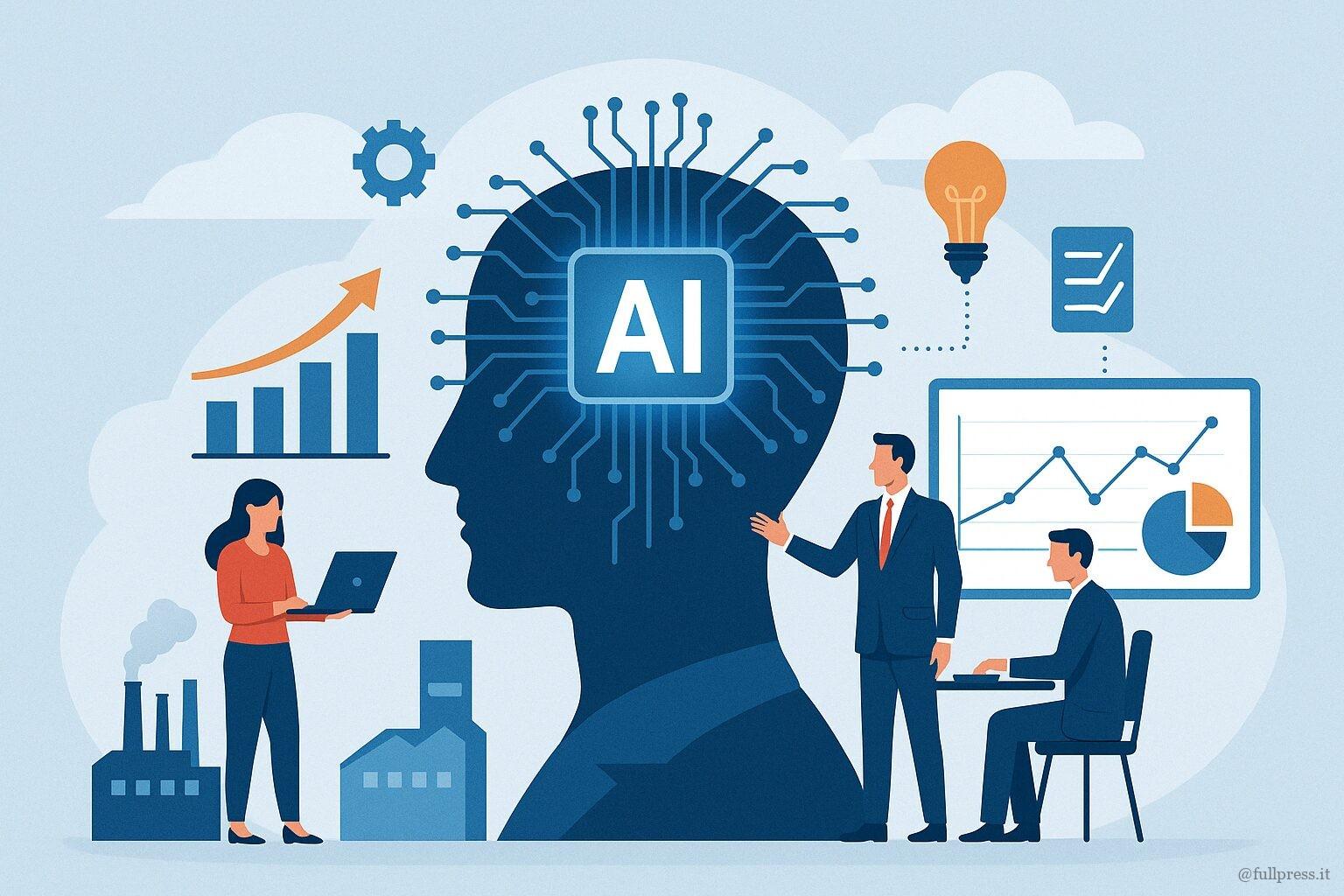
AI in decision-making processes: from data to strategy
Today, companies collect more data than ever before. But collecting is not enough: it requires the ability to read, interpret, and act, as well as protect it. AI is the key that allows chaotic amounts of information to be transformed into actionable insights.
For example, a company operating in multiple markets can analyze local purchasing behaviors and tailor offers, prices, or communication in a hyper-personalized way.
At the same time, an HR department can use AI to identify productivity or turnover risk patterns, anticipating dynamics that would otherwise emerge too late.
In short, the added value is clear, but AI is not a plug-and-play mechanism, i.e., a pre-packaged solution, so it benefits those who can harness its potential, which is still largely unexplored.
To integrate AI and benefit from it, one must start with a deep understanding of the company’s reality: analyze objectives, processes, available data, internal resources, and areas for improvement. Only then is it possible to build aa model that really works, without wasting time or budget.
The adoption of artificial intelligence is, in fact, a strategic decision that impacts how a company grows, reacts, and innovates. And to do it really well, you need expertise, methodand expert guidanceto rely on.
Pubblicato in Artificial Intelligence, Business
Be the first to comment