
Over the summer, the Italian Postal Police issued a warning to users: among the usual emails offering low-priced medicines from dubious online shops and alleged invoices, a threatening message of a sexual nature stood out. A scam still active to the detriment of unwary users.
Add us to your preferred sources.

The email that has been flooding the inboxes of many Italian users and beyond since the beginning of summer has left many users stunned. It is a threatening message with the subject line “I filmed you..”. Apparently, someone has used the notebook’s webcam to record a compromising video of the user.
This video the sender threatens to publish if a sum of 250 dollars / 300 Euros is not received inBitcoinwithin 5 days (in some cases even within two days) of sending the message. A typical example of “sextortion“, the pornographic email is nothing more than a scam: there are no compromising videos that could be published by anyone.
Surely upon reading this message, some readers’ blood will have run cold and many will have wondered if what was stated was true. And it is precisely at this stage that the risk of falling into the trap or giving in to the alleged blackmail is exponential. Fear leads individuals to act instinctively, pushing us to flee or attack without thinking to defend ourselves from direct physical harm. A mechanism undoubtedly known to criminals as well.
As with all attacks perpetrated via email, it is important to remember that there is no imminent risk to your life or safety that requires direct and immediate action.
Oops! Can the camera film me secretly?
This question undoubtedly torments most recipients of such messages. In theory, it is possible, with the help of malicious software, to activate a webcam remotely without being noticed. In this specific case, however, the criminals are simply relying on their message being believed. But even if the laptop is mostly closed and connected to a monitor and keyboard via a docking station, or the PCdoes not have a webcam, at first glance one gets scared.
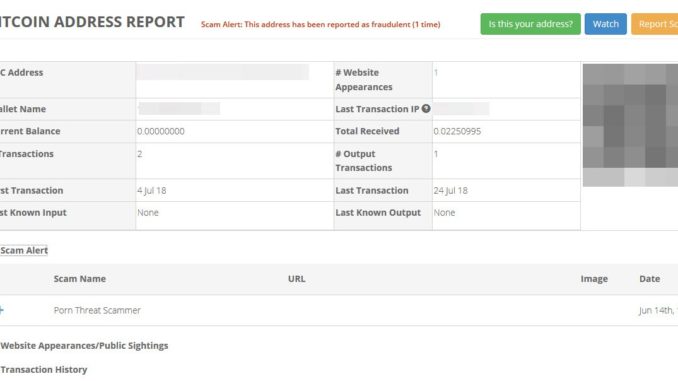
The emails provide a bitcoin address where the necessary amount to buy the sender’s silence should be deposited. A quick web search, however, revealed that the specific bitcoin wallet indicated in the threatening message contained no active transactions, apart from a single deposit of approximately 300 Euros. On a website (e.g., www.bitcoinwhoswho.com) the wallet is even labeled as “suspicious in conjunction with scam cases”. Another sure sign that you cannot trust it.
Clear signs: attention please!
Lexical anomalies:
The lexicon of threatening emails has improved a lot over the last few years. Despite this, cases still occur where the automatic translation program does not quite hit the mark.
Bitcoin address:
Cybercriminals often create “disposable” wallets to perpetrate a scam, usable only for a limited time. An appropriate search of these Bitcoin wallet addresses can provide further clarification. In fact, those contained in this type of threatening message are quickly flagged as fraudulent. And there is no need to worry, because criminals have no way of tracking the research activities conducted by any user.
Overwhelming scenario:
For fear to take over, the victim must feel absolutely powerless. For this reason, this type of email emphasizes the sender’s superiority, able on the one hand to monitor every single movement of the user, especially any requests for help, and on the other hand to be untraceable due to their ability to “never” make mistakes.
The perfidy of this email lies in wanting to obtain payment of sums of money by staging a particularly anxiety-provoking situation. A scam whose costs, like the risk of being exposed, are very low for cybercriminals. That is why it is necessary for the user to remain vigilant!
For all messages of this type, whose objective is to extort sums of money, the following rules apply:
- Keep calm
- Do not make any payment
- Delete the email.
Be the first to comment